
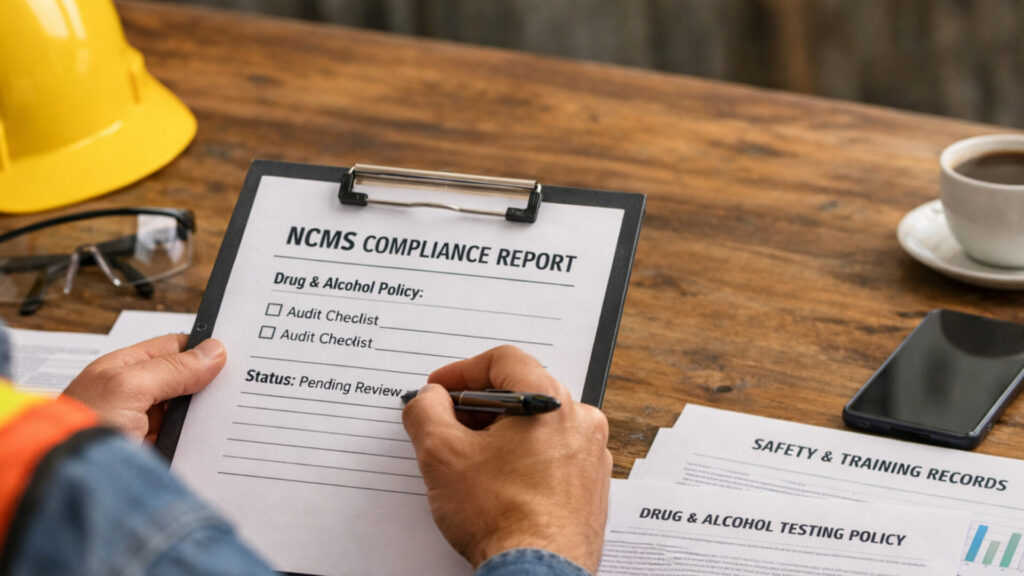
What is NCMS?
If a hiring client has told your company that you need NCMS, you are probably asking the same question almost every contractor asks the first time they hear it. NCMS refers to National Compliance Management Service. Public NCMS materials describe the company as a leader in oil and gas contractor monitoring, and NCMS also states clearly that it is not a government agency.
That distinction matters.
A lot of contractors and suppliers assume NCMS is a government portal or just another basic registration website. It is not. NCMS is part of the contractor compliance process used by certain hiring clients to evaluate and monitor drug and alcohol program requirements and related contractor obligations, particularly in pipeline and other safety-sensitive environments. NCMS publicly describes its services as including initial audits, ongoing monitoring, pipeline safety support, and drug and alcohol program monitoring.
So in plain language, NCMS is not just an account you create and forget about. It is a system that can directly affect whether your company is ready to work for certain clients.
Need NCMS compliance right away? Let’s get started: NCMS® Management Plan | NCMS Compliance | Cascade QMS
Why contractors and suppliers get asked for NCMS
Most companies do not go looking for NCMS on their own. They are told they need it because a client, owner-operator, or hiring company requires it as part of contractor qualification.
That is why NCMS often shows up in the middle of a job opportunity, a prequalification process, or a last-minute compliance request. A contractor may be ready to mobilize, only to find out that its drug and alcohol policy, testing program, audit response, or related documentation must first go through NCMS review.
This is one of the biggest reasons contractors get frustrated. They are focused on operations, manpower, and production, while the hiring client is focused on risk, documentation, and contractor oversight. NCMS sits right in the middle of that gap.
What does NCMS actually do?
NCMS is best understood as a contractor monitoring and review system that supports hiring clients in evaluating whether contractor drug and alcohol programs meet required standards. NCMS says its services include initial audits, ongoing monitoring, pipeline safety support, and drug and alcohol program monitoring.
That means NCMS is not just storing paperwork. It is part of a review process.
Depending on the client and the type of work involved, contractors may need to submit policies, testing-program details, audit responses, and related compliance information for review. In public contractor guidance, hiring clients describe NCMS as the third-party reviewer or auditor for contractor drug and alcohol plans and state that contractors may need approved programs before performing certain covered work.
In real-world terms, NCMS often becomes the checkpoint between “we want to do the work” and “we are approved to do the work.”
Is NCMS only for oil and gas contractors?
NCMS publicly describes itself as a leader in oil and gas contractor monitoring, so that is the sector most closely associated with it.
But the companies affected are not limited to one narrow contractor type. The requirement can impact contractors and suppliers involved in pipeline work, field services, maintenance, inspection, construction, specialty services, and other scopes where hiring clients require more formal oversight of drug and alcohol compliance programs.
So while NCMS is strongly tied to oil and gas and pipeline-related environments, the businesses that need it can be much broader than people first assume.
Which hiring clients require NCMS?
A smart way to answer this is with public examples from companies that openly reference NCMS in their contractor requirements.
Kinder Morgan states that it has established a business relationship with NCMS to help ensure contractors meet expectations for a compliant DOT/PHMSA drug and alcohol program. Kinder Morgan also says that once a contractor is determined to be performing PHMSA-covered job functions, NCMS begins the audit review process, and failure to provide necessary information may delay the contractor’s ability to perform covered functions. Kinder Morgan’s contractor safety manual also states that where required in the U.S., NCMS evaluates the contractor’s drug and alcohol programs and that the plan must be submitted to NCMS for evaluation and company approval.
Trans Mountain publicly states that contractors performing work on or around pipelines involving DOT-covered tasks must meet PHMSA-aligned standards, and that these programs are subject to review by its third-party auditor, National Compliance Management Service (NCMS). Trans Mountain further indicates that once a contractor is identified as performing PHMSA-covered functions, NCMS initiates the audit and review process. Their contractor guidance also notes that only contractors performing covered tasks are subject to these requirements. with approved drug and alcohol testing programs will be allowed to perform DOT-covered tasks, and for contractors registered in ISNetworld, information is downloaded from NCMS to the ISNetworld contractor dashboard.
Enbridge goes a step further in its public contractor policy by stating that a contractor must have a drug and alcohol policy approved by NCMS and reported as satisfactory in ISNetworld for subscribed contractors, or satisfactory in the NCMS database for contractors not requiring an ISNetworld subscription. Enbridge’s policy also says having a current and effective contractor policy approved by Enbridge is a condition precedent for being permitted to perform work, and it describes NCMS receiving and reviewing the contractor’s proposed policy and related documentation for adherence to company requirements and U.S. DOT requirements.
These examples matter because they show that NCMS is not hypothetical. It is built into real contractor compliance workflows used by major hiring clients.
What contractors usually need help with in NCMS
This is where things become very practical. Most contractors do not struggle because they cannot create a login. They struggle because the requirement is tied to real program details. The issue is usually not “how do I sign up?” It is “what exactly do they want from us, and how do we make sure it is acceptable?”
Depending on the client and work scope, contractors may need help with a drug and alcohol policy, testing-program alignment, audit responses, employee or covered-worker information, supporting documentation, ongoing updates,
and communication tied to the hiring client’s compliance expectations.
Public client requirements from Kinder Morgan, Trans Mountain, and Enbridge all point in that direction. They describe NCMS as part of plan review, audit review, approval workflows, and ongoing compliance expectations tied to contractor eligibility.
In other words, NCMS becomes a problem when a company has incomplete documents, an outdated program, inconsistent records, or nobody internally who really understands how to manage the process.
NCMS setup versus NCMS management
This is an important distinction, and it is one worth making clearly in the blog because it matches the way contractors actually search.
NCMS setup is the front end. That is when a contractor is first told to enroll, respond to an audit, provide information, or get its program reviewed.
NCMS management is the ongoing side. That means keeping documentation current, handling updates, responding to requests, managing changes in scope or personnel, and making sure the account and related program stay aligned with what the hiring client expects.
NCMS itself describes its services not just as initial audits, but also as ongoing monitoring.
That is why many contractors and suppliers need more than one-time help. They need someone paying attention after the initial setup is complete.
NCMS vs. ISNetworld
A lot of contractors hear about NCMS around the same time they hear about ISNetworld, so the two systems often get blended together. They are not the same thing.
ISNetworld is a broader contractor management and prequalification platform used by many hiring clients to collect and manage company-level safety, insurance, training, and compliance information.
NCMS, by contrast, is used in public hiring-client workflows as a specialized reviewer or monitor tied to contractor drug and alcohol program requirements and related approvals. Public Trans Mountain and Enbridge materials also show that NCMS outcomes may flow into ISNetworld for contractors that are subscribed there.
That means a contractor may need both systems working properly at the same time.
If your company is being told to satisfy NCMS, it may not be a standalone issue. It may also affect how your company appears to the hiring client inside ISNetworld.
What happens if NCMS is not handled correctly?
For contractors, the biggest consequence is usually delay. Kinder Morgan states that failure to provide necessary information to NCMS may delay the audit process and a contractor’s ability to perform covered functions. Trans Mountain says only contractors with approved drug and alcohol testing programs will be allowed to perform DOT-covered tasks. Enbridge states that an effective contractor policy approved under its framework is a condition precedent to performing work and that contractors are not to be permitted to work without an NCMS-approved contractor policy.
In the real world, that can mean delayed mobilization, a stalled onboarding process, frustrated client contacts, and lost revenue opportunities.
For many smaller contractors and suppliers, those delays are not just inconvenient. They can materially affect the business.
Why many companies outsource NCMS help
Most contractors are not in the compliance business. They are in the business of building, repairing, maintaining, staffing, supporting, or operating.
That is why outsourced help is valuable.
When a company assigns NCMS to someone who is already overloaded, such as an owner, office manager, operations lead, or project administrator, things often get pushed aside until the client deadline becomes urgent. By then, the process feels more stressful than it needs to be.
Specialized help with NCMS can reduce that pressure by giving the contractor support with account setup, document coordination, audit responses, and ongoing account upkeep. For a company that wants to stay focused on the work itself, that kind of support can be a major advantage.
So, what is NCMS?
The clearest answer is this:
NCMS is a contractor compliance monitoring and review system used by certain hiring clients to evaluate and monitor drug and alcohol program requirements and related contractor obligations. It is especially associated with oil, gas, and pipeline-related environments, and it can directly affect whether a contractor or supplier is approved to perform certain work. NCMS also states that it is not a government agency.
For contractors and suppliers, that means NCMS is not just a box to check. It is part of the larger process of staying eligible, compliant, and ready for client opportunities.
Need help with NCMS setup or NCMS management?
If your company has been told it needs NCMS, the smartest move is to get in front of it early.
Cascade QMS helps contractors and suppliers with NCMS account setup, account maintenance, compliance support, and ongoing management assistance. Whether you are trying to understand what a hiring client is asking for, respond to an NCMS audit, or keep your account current throughout the year, having experienced support can save time and help reduce approval delays.
If you need help with NCMS, Cascade QMS is here to support you.
FAQ Section
What does NCMS stand for?
NCMS refers to National Compliance Management Service. Public NCMS materials also state that NCMS is not a government agency.
What is NCMS used for?
NCMS is used in public hiring-client workflows to review and monitor contractor drug and alcohol program requirements and related compliance obligations. NCMS describes its services as including initial audits and ongoing monitoring.
Which companies require NCMS?
Public contractor requirements referencing NCMS are available from companies including Kinder Morgan, Trans Mountain, and Enbridge.
Is NCMS the same as ISNetworld?
No. NCMS and ISNetworld are different systems, though public hiring-client materials show they may work together in certain contractor review workflows.
Can someone manage my NCMS account for me?
Yes. Many contractors choose outside help for NCMS setup and management so they can stay focused on operations while a compliance specialist handles the administrative side.
Reach out to receive a call from an NCMS expert! Click here: Contact Us! | Cascade QMS