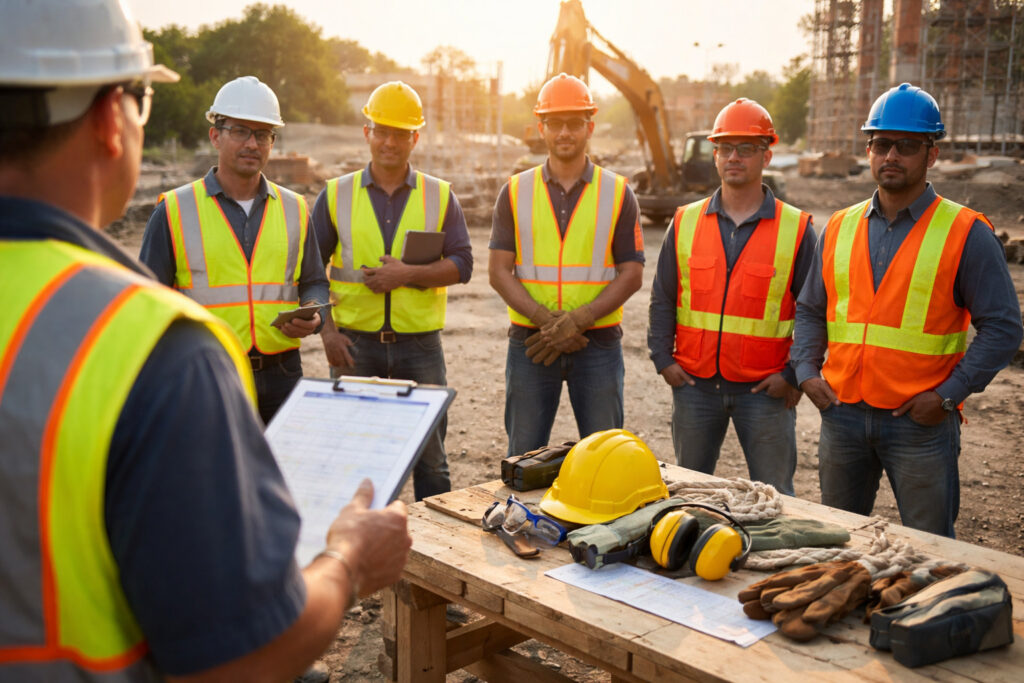
Toolbox talks are short, focused safety meetings held before work begins, during a shift change, or ahead of a high-risk task. They are designed to keep safety top of mind, address the hazards workers are most likely to face that day, and reinforce the safe work practices that prevent injuries, delays, and costly mistakes. While toolbox talks are simple in format, they play an important role in the larger safety and health program. OSHA specifically points to daily planning meetings, huddles, toolbox talks, and tailgate meetings as effective ways to engage workers in safety and health programs.
For many contractors, toolbox talks are no longer just a good habit. They are part of what separates companies that look organized, proactive, and contract-ready from companies that appear reactive or underdeveloped. In today’s environment, hiring clients, prime contractors, and contractor management platforms are paying much closer attention to how companies communicate safety expectations, track worker readiness, and maintain training consistency across the workforce. ISNetworld says it collects and reviews contractor health, safety, and training information, while Avetta highlights tracking worker qualifications, certifications, and training, and Veriforce promotes documentation uploads that include training records, JSAs, and safety programs.
Ready to boost your safety culture? Learn about Cascade QMS Toolbox Talk Subscriptions by clicking here!
Toolbox Talks Are About More Than “Covering a Topic”
A lot of companies treat toolbox talks like a box to check. A supervisor reads a sheet, gets signatures, and moves on. That approach may create paper, but it does not necessarily create awareness, accountability, or a stronger safety culture.
The real value of a toolbox talk is in repetition, relevance, and consistency. When workers hear safety expectations regularly, they are more likely to remember them in the field. When the topic is tied to the actual work being performed, the message feels practical instead of generic. When the company holds these meetings consistently, workers begin to understand that safety is not an occasional priority — it is part of how the business operates every day.
That consistency matters because safety culture is built through repeated behavior. A written program may explain what the company expects, but toolbox talks help translate that program into daily action. They give supervisors a structured way to reinforce standards, remind crews about job hazards, discuss recent incidents or near misses, and keep communication open between leadership and the field. OSHA’s guidance emphasizes worker participation, ongoing hazard identification, and frequent communication as core elements of an effective safety and health program.
Why Toolbox Talk Consistency Matters
Inconsistent safety meetings create inconsistent results. If toolbox talks only happen after an incident, before an audit, or when a client starts asking questions, employees notice. It sends the message that safety is important only when something goes wrong.
Consistent toolbox talks help companies create rhythm and accountability. They support onboarding for new workers, refresh experienced employees on recurring hazards, and help supervisors keep safety visible in a practical way. Over time, that consistency can improve hazard recognition, strengthen communication, and reduce the chances that important controls get skipped because a crew is rushed, distracted, or overly familiar with the task.
Consistency also makes your company easier to trust. When a hiring client, auditor, or prequalification reviewer looks at your operation, they want to see more than a policy manual. They want evidence that the company is actually implementing its safety expectations. Regular toolbox talks, paired with documented attendance and relevant topics, help demonstrate that your safety program is active rather than theoretical. That is an important distinction for companies trying to win work with major clients.
Why Safety Videos Have Become So Helpful
Written toolbox talks still matter, but video-based toolbox talks have become increasingly valuable because they help companies deliver training in a way that is more engaging, easier to standardize, and often easier for supervisors to roll out consistently. Many contractors now have crews spread across multiple jobsites, shifting schedules, and varied experience levels. Video helps create a more consistent message across those teams.
It also supports comprehension. Some workers absorb information better by hearing and seeing it rather than reading from a printed sheet. A short, well-made video can help reinforce key points, illustrate real-world scenarios, and make the message feel more immediate. Videos are especially useful for refresher training, multilingual teams, remote crews, and companies trying to improve participation without dramatically increasing administrative burden.
That does not mean videos should replace discussion. The strongest approach is usually a blend: a short video, a brief supervisor-led conversation, and documented attendance. That combination gives companies the consistency of a standardized message while still leaving room to address site-specific hazards, weather conditions, equipment issues, client rules, or lessons learned from recent work.
Toolbox Talks Help Build Real Safety Culture
A stronger safety culture does not come from slogans. It comes from leadership habits, worker participation, and repeated follow-through. Toolbox talks support all three.
They show workers that management is willing to dedicate time to safety before productivity takes over the day. They create a space for employees to raise concerns, ask questions, and share what they are seeing in the field. They also help connect big-picture safety expectations to the real tasks people are performing, whether that is excavation, electrical work, driving, hot work, confined space entry, line clearing, equipment operation, or general jobsite housekeeping.
When done well, toolbox talks can improve morale too. Workers want to know that their employer is paying attention to their safety, not just their output. A company that communicates hazards clearly, responds to concerns, and reinforces safe work practices consistently tends to earn more credibility with its workforce. That credibility matters when you need people to speak up, follow procedures, and make better decisions under pressure.
Why Toolbox Talks Matter in Prequalification Systems
This is where toolbox talks become even more important from a business standpoint.
Prequalification systems and contractor management platforms increasingly revolve around more than just injury rates and insurance certificates. Contractors are often expected to show organized safety programs, employee training, worker qualifications, site readiness, and in some cases evidence of ongoing implementation. ISNetworld promotes collection and review of contractor health, safety, and training information. Avetta highlights verifying and tracking worker qualifications, certifications, and training, including virtual training and site inductions. Veriforce similarly emphasizes contractor qualification, training, certifications, and documentation uploads.
That does not mean every system asks for “toolbox talks” in exactly the same way. But as a practical matter, regular toolbox talks help companies produce the kind of repeatable, documented training activity that supports stronger compliance posture and client confidence. That is a reasonable inference from how these platforms frame contractor qualification and worker readiness.
In other words, toolbox talks help bridge the gap between written safety programs and daily execution. They show that your company is not just submitting documents to pass prequalification. You are actively communicating hazards, reinforcing procedures, and maintaining a living safety process.
Customization Is What Makes Toolbox Talks Effective
One of the biggest mistakes companies make is relying on generic topics that do not match the work. A toolbox talk on office ergonomics is not much help to a crew dealing with trenching, energized equipment, dropped-object exposure, heat stress, chainsaw use, traffic control, or line-of-fire hazards.
The best toolbox talks are tailored to the work environment, season, client expectations, and task risks. They should reflect what crews are actually facing. That may include weather exposure, utility work, contractor driving risks, lockout/tagout, hand and power tools, H2S, confined spaces, fire danger precautions, incident reporting, or cybersecurity topics tied to client requirements. Customization makes the meeting more credible, more useful, and far more likely to influence behavior.
It also helps companies align training with the industries they serve. A contractor working in utilities, oil and gas, forestry, manufacturing, renewables, or industrial construction should not be using the same exact safety content for every crew, every month, and every client.
Documentation Still Matters
A strong toolbox talk is only half the equation. Documentation matters too.
If your company is conducting regular toolbox talks, keep the process organized. Maintain the topic, date, supervisor, attendance, and any notes about site-specific discussion or worker questions. If a topic is tied to a known incident trend, seasonal hazard, client request, or recent observation, note that as well. Good documentation supports internal accountability, helps during audits or client reviews, and gives your company a clearer record of what has actually been communicated to the workforce.
This is particularly important for growing contractors. As companies add crews, expand into new states, take on new clients, or move into more heavily regulated work, informal safety communication becomes harder to manage. A consistent toolbox talk process helps bring structure to that growth.
Need a few Toolbox Talks to get your through a project? Order them HERE!
Toolbox Talks Are a Smart Investment, Not Just a Safety Task
Companies often think about toolbox talks as an administrative responsibility. In reality, they are a low-cost way to support multiple business goals at once.
They can help reduce incidents, strengthen frontline communication, reinforce written programs, support onboarding, keep safety visible, and demonstrate a more mature operational approach to clients and prequalification reviewers. They also help supervisors lead more effectively because they provide a simple framework for regular safety communication.
For contractors trying to grow, that matters. Winning larger contracts often requires more than technical ability. It requires presenting your company as organized, trainable, reliable, and safe to work with. Toolbox talks contribute to that picture.
Final Thoughts
Toolbox talks may be brief, but their impact can be significant when they are relevant, consistent, and backed by a larger safety system. They help turn written expectations into daily habits. They strengthen communication between the office and the field. They support a stronger safety culture. And in a world where contractor prequalification systems increasingly focus on documentation, training, qualifications, and operational readiness, they can also help your company look more prepared to meet client expectations.
At Cascade QMS, we help contractors build toolbox talk systems that are practical, professional, and aligned with real-world compliance demands. Whether you need written toolbox talks, toolbox talk videos, customized safety topics, or support tying your training materials into your broader safety and prequalification strategy, we can help.
Need toolbox talks your supervisors will actually use? Contact Cascade QMS for written toolbox talks, toolbox talk videos, and customized safety support built for growing contractors. Request more information here!